
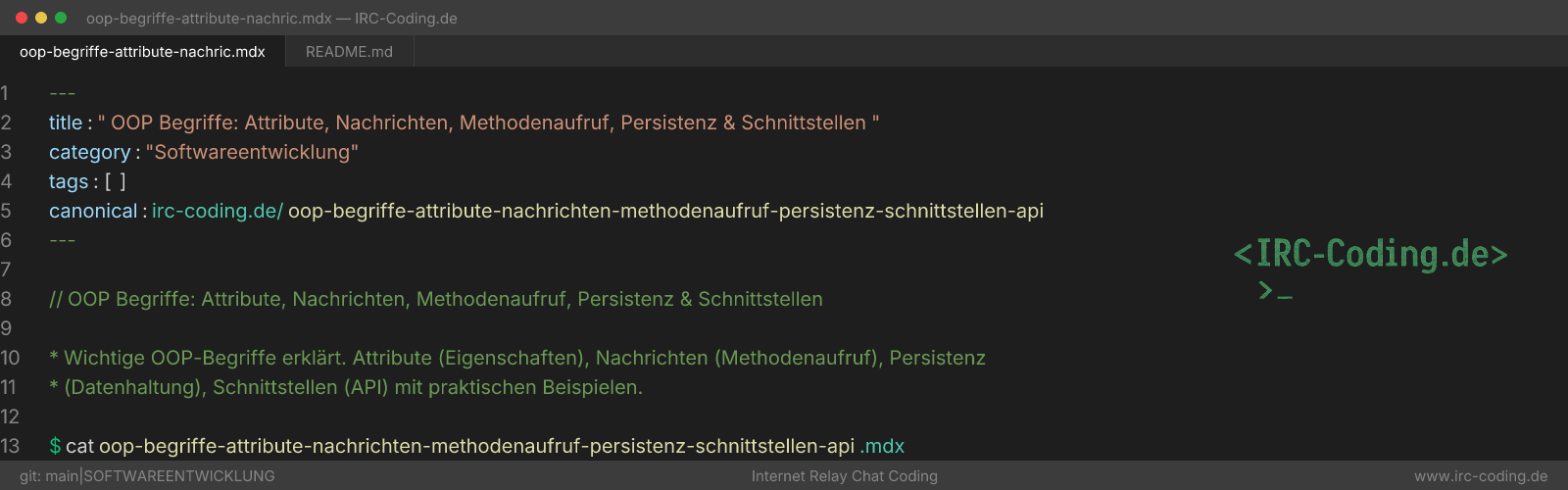
OOP Concepts: Attributes, Messages, Method Calls, Persistence & Interfaces

This guide covers the essential OOP concepts in depth—attributes, messages, method calls, persistence, and interfaces—with practical examples throughout.
In a Nutshell
OOP concepts describe the fundamental building blocks of object-oriented programming: attributes as data properties, messages as object communication, persistence as data storage, and interfaces as contracts between components.
Technical Overview
Object-oriented programming (OOP) uses specific terminology to describe its core concepts and structures.
Attribute (Attribute/Field/Property)
An attribute is a property or state that belongs to an object. It represents the data an object holds.
Key characteristics:
- Data type: Determines what kind of data is stored (string, int, boolean, etc.)
- Visibility: public, private, protected, or package-level
- Value: The current state of the property
- Lifetime: Exists as long as the object exists
Message (Message/Method Call)
A message is communication between objects. It tells one object to perform a specific action.
Components:
- Receiver: The object that receives the message
- Method name: Which operation to invoke
- Arguments: Parameters passed to the method
- Return value: The result of the operation
Persistence (Persistence)
Persistence refers to data that survives beyond the program’s execution.
Common forms of persistence:
- Filesystem: Serializing data to files
- Databases: Relational or NoSQL systems
- Cloud storage: External storage services
- In-memory: Temporary persistence during runtime
Interface (Interface/API)
An interface defines a contract between components and specifies which operations are available.
Types of interfaces:
- Programming interfaces: Method signatures and APIs
- Web APIs: HTTP endpoints
- User interfaces: GUI components
- Hardware interfaces: Device drivers
Key Study Points
- Attributes: Data properties of objects with access control
- Messages: Object-to-object communication via method calls
- Method calls: Executing operations on objects
- Persistence: Long-term data storage beyond program lifetime
- Interfaces: Contracts between components with defined APIs
- Encapsulation: Bundling data and methods as a unit
- Abstraction: Hiding complexity through simplification
- Industry relevance: Fundamental to professional OOP development
Core Components
- Attributes: Data properties of objects
- Messages: Communication between objects
- Methods: Implementation of behavior
- Persistence: Long-term data storage
- Interfaces: Defined contracts
- Encapsulation: Grouping data and methods together
- Abstraction: Reducing complexity
- Polymorphism: Multiple implementations of an interface
Practical Examples
1. Attributes in Different Languages
// Java Attributes
public class Auto {
    // Instance attributes (per object)
    private String marke;           // Private property
    protected int baujahr;          // Protected property
    public double preis;            // Public property

    // Class attribute (shared by all instances)
    private static int anzahlAutos = 0;

    // Constant
    public static final int MAX_GESCHWINDIGKEIT = 250;

    // Constructor for initialization
    public Auto(String marke, int baujahr, double preis) {
        this.marke = marke;
        this.baujahr = baujahr;
        this.preis = preis;
        Auto.anzahlAutos++; // Increment class attribute
    }

    // Getter and setter for encapsulated attributes
    public String getMarke() {
        return marke;
    }

    public void setMarke(String marke) {
        this.marke = marke;
    }

    public static int getAnzahlAutos() {
        return anzahlAutos;
    }
}
// C# Attributes
public class Mitarbeiter
{
// Auto-properties (modern syntax)
public string Name { get; set; }
public int Alter { get; private set; } // Read-only from outside
// Full property with validation
private double gehalt;
public double Gehalt
{
get { return gehalt; }
set
{
if (value >= 0)
gehalt = value;
else
throw new ArgumentException("Gehalt kann nicht negativ sein");
}
}
// Static property
public static string Firma { get; set; } = "TechCorp";
// Constant
public const decimal MINDESTGEHALT = 2000m;
public Mitarbeiter(string name, int alter, double gehalt)
{
Name = name;
Alter = alter;
Gehalt = gehalt;
}
}# Python Attributes
class Person:
# Class attribute
anzahl_personen = 0
def __init__(self, name, alter):
# Instance attributes
self.name = name # Public
self._alter = alter # Protected (convention)
self.__geheim = "data" # Private (name mangling)
Person.anzahl_personen += 1
# Property for encapsulated access
@property
def alter(self):
return self._alter
@alter.setter
def alter(self, wert):
if wert >= 0:
self._alter = wert
else:
raise ValueError("Alter kann nicht negativ sein")
# Static method
@staticmethod
def get_anzahl_personen():
return Person.anzahl_personen2. Messages and Method Calls
// Messages between objects
public class Bankkonto {
    private double kontostand;
    private String kontonummer;

    public Bankkonto(String kontonummer, double startbetrag) {
        this.kontonummer = kontonummer;
        this.kontostand = startbetrag;
    }

    // Method to receive messages
    public void einzahlen(double betrag) {
        if (betrag > 0) {
            this.kontostand += betrag;
            System.out.println("Einzahlung: " + betrag + "€, neuer Kontostand: " + kontostand + "€");
        }
    }

    public boolean abheben(double betrag) {
        if (betrag > 0 && kontostand >= betrag) {
            kontostand -= betrag;
            System.out.println("Abhebung: " + betrag + "€, neuer Kontostand: " + kontostand + "€");
            return true;
        }
        return false;
    }

    public double getKontostand() {
        return kontostand;
    }

    public String getKontonummer() {
        return kontonummer;
    }
}

// Customer sends messages to bank account
public class Kunde {
    private String name;
    private Bankkonto konto;

    public Kunde(String name, Bankkonto konto) {
        this.name = name;
        this.konto = konto;
    }

    // Customer sends messages to their account
    public void geldEinzahlen(double betrag) {
        System.out.println(name + " will " + betrag + "€ einzahlen");
        konto.einzahlen(betrag);  // Send message
    }

    public boolean geldAbheben(double betrag) {
        System.out.println(name + " will " + betrag + "€ abheben");
        return konto.abheben(betrag);  // Send message
    }

    public void kontostandPruefen() {
        double stand = konto.getKontostand();  // Send message
        System.out.println(name + "'s Kontostand: " + stand + "€");
    }
}

// Using messages
public class BankingDemo {
    public static void main(String[] args) {
        Bankkonto konto = new Bankkonto("DE123456789", 1000.0);
        Kunde kunde = new Kunde("Max Mustermann", konto);

        // Message chain
        kunde.geldEinzahlen(500.0);
        kunde.kontostandPruefen();

        if (kunde.geldAbheben(200.0)) {
            System.out.println("Abhebung erfolgreich");
        }

        kunde.kontostandPruefen();
    }
}
3. Implementing Persistence
// Serialization for file persistence
import java.io.*;
import java.util.*;

public class PersistenceDemo {

    // Serializable class
    static class Product implements Serializable {
        private static final long serialVersionUID = 1L;

        private String id;
        private String name;
        private double price;
        private transient Date lastModified; // transient = not serialized

        public Product(String id, String name, double price) {
            this.id = id;
            this.name = name;
            this.price = price;
            this.lastModified = new Date();
        }

        // Getters and toString
        public String getId() { return id; }
        public String getName() { return name; }
        public double getPrice() { return price; }

        @Override
        public String toString() {
            return String.format("Product[id=%s, name=%s, price=%.2f]", id, name, price);
        }
    }

    // Persistence manager
    static class PersistenceManager {
        private String filename;

        public PersistenceManager(String filename) {
            this.filename = filename;
        }

        // Save objects
        public void saveProducts(List<Product> products) throws IOException {
            try (ObjectOutputStream oos = new ObjectOutputStream(
                    new FileOutputStream(filename))) {
                oos.writeObject(products);
                System.out.println("Products saved to " + filename);
            }
        }

        // Load objects
        @SuppressWarnings("unchecked")
        public List<Product> loadProducts() throws IOException, ClassNotFoundException {
            try (ObjectInputStream ois = new ObjectInputStream(
                    new FileInputStream(filename))) {
                List<Product> products = (List<Product>) ois.readObject();
                System.out.println("Products loaded from " + filename);
                return products;
            }
        }
    }

    // JSON persistence (manual)
    static class JsonPersistence {
        public static void saveAsJson(List<Product> products, String filename) throws IOException {
            try (BufferedWriter writer = Files.newBufferedWriter(Paths.get(filename))) {
                writer.write("[\n");
                for (int i = 0; i < products.size(); i++) {
                    Product p = products.get(i);
                    writer.write(String.format(
                        "  {\"id\": \"%s\", \"name\": \"%s\", \"price\": %.2f}",
                        p.getId(), p.getName(), p.getPrice()
                    ));
                    if (i < products.size() - 1) {
                        writer.write(",\n");
                    }
                }
                writer.write("\n]");
            }
            System.out.println("Products saved as JSON");
        }
    }

    public static void main(String[] args) {
        List<Product> products = Arrays.asList(
            new Product("P001", "Laptop", 999.99),
            new Product("P002", "Mouse", 29.99),
            new Product("P003", "Keyboard", 79.99)
        );

        PersistenceManager manager = new PersistenceManager("products.ser");

        try {
            // Serialization
            manager.saveProducts(products);

            // Deserialization
            List<Product> loadedProducts = manager.loadProducts();
            loadedProducts.forEach(System.out::println);

            // JSON persistence
            JsonPersistence.saveAsJson(products, "products.json");

        } catch (IOException | ClassNotFoundException e) {
            e.printStackTrace();
        }
    }
}
4. Interfaces and APIs
// Programming interface
interface DatabaseInterface {
    // Abstract methods (no implementation)
    void connect() throws DatabaseException;
    void disconnect();
    boolean isConnected();

    // Query methods
    List<Map<String, Object>> query(String sql) throws DatabaseException;
    int execute(String sql) throws DatabaseException;

    // Default methods (since Java 8)
    default void connectWithTimeout(int timeout) throws DatabaseException {
        connect(); // Standard implementation
    }
}

// Custom exception class
class DatabaseException extends Exception {
    public DatabaseException(String message) {
        super(message);
    }

    public DatabaseException(String message, Throwable cause) {
        super(message, cause);
    }
}

// Concrete implementation
class MySQLDatabase implements DatabaseInterface {
    private boolean connected = false;
    private String connectionString;

    public MySQLDatabase(String connectionString) {
        this.connectionString = connectionString;
    }

    @Override
    public void connect() throws DatabaseException {
        try {
            // Simulated connection
            System.out.println("Connecting to MySQL: " + connectionString);
            Thread.sleep(1000); // Simulate network latency
            connected = true;
            System.out.println("Connection established");
        } catch (InterruptedException e) {
            throw new DatabaseException("Connection interrupted", e);
        }
    }

    @Override
    public void disconnect() {
        if (connected) {
            System.out.println("Connection closed");
            connected = false;
        }
    }

    @Override
    public boolean isConnected() {
        return connected;
    }

    @Override
    public List<Map<String, Object>> query(String sql) throws DatabaseException {
        if (!connected) {
            throw new DatabaseException("Not connected");
        }

        System.out.println("Executing: " + sql);

        // Simulated result
        List<Map<String, Object>> result = new ArrayList<>();
        Map<String, Object> row = new HashMap<>();
        row.put("id", 1);
        row.put("name", "Test data");
        result.add(row);

        return result;
    }

    @Override
    public int execute(String sql) throws DatabaseException {
        if (!connected) {
            throw new DatabaseException("Not connected");
        }

        System.out.println("Executing: " + sql);
        return 1; // Simulated affected rows
    }
}

// API usage
public class ApiDemo {
    public static void main(String[] args) {
        // Polymorphic use via interface
        DatabaseInterface db = new MySQLDatabase("jdbc:mysql://localhost/test");

        try {
            // Work through the interface
            db.connect();

            if (db.isConnected()) {
                List<Map<String, Object>> result = db.query("SELECT * FROM customers");
                System.out.println("Result: " + result.size() + " rows");

                int rows = db.execute("UPDATE customers SET status = 'active'");
                System.out.println("Affected rows: " + rows);
            }

        } catch (DatabaseException e) {
            System.err.println("Database error: " + e.getMessage());
        } finally {
            db.disconnect();
        }
    }
}
5. Web API Example
// REST API Controller (Spring Boot example)
@RestController
@RequestMapping("/api/customers")
public class CustomerAPI {

    private final CustomerService service;

    public CustomerAPI(CustomerService service) {
        this.service = service;
    }

    // GET /api/customers/{id}
    @GetMapping("/{id}")
    public ResponseEntity<Customer> getCustomer(@PathVariable Long id) {
        try {
            Customer customer = service.findCustomerById(id);
            return ResponseEntity.ok(customer);
        } catch (CustomerNotFoundException e) {
            return ResponseEntity.notFound().build();
        }
    }

    // POST /api/customers
    @PostMapping
    public ResponseEntity<Customer> createCustomer(@RequestBody Customer customer) {
        Customer createdCustomer = service.createCustomer(customer);
        return ResponseEntity.status(HttpStatus.CREATED).body(createdCustomer);
    }

    // PUT /api/customers/{id}
    @PutMapping("/{id}")
    public ResponseEntity<Customer> updateCustomer(@PathVariable Long id, @RequestBody Customer customer) {
        try {
            Customer updatedCustomer = service.updateCustomer(id, customer);
            return ResponseEntity.ok(updatedCustomer);
        } catch (CustomerNotFoundException e) {
            return ResponseEntity.notFound().build();
        }
    }

    // DELETE /api/customers/{id}
    @DeleteMapping("/{id}")
    public ResponseEntity<Void> deleteCustomer(@PathVariable Long id) {
        service.deleteCustomer(id);
        return ResponseEntity.noContent().build();
    }
}

// Data model
class Customer {
    private Long id;
    private String name;
    private String email;
    private LocalDate birthDate;

    // Getters and setters
    public Long getId() { return id; }
    public void setId(Long id) { this.id = id; }
    public String getName() { return name; }
    public void setName(String name) { this.name = name; }
    public String getEmail() { return email; }
    public void setEmail(String email) { this.email = email; }
    public LocalDate getBirthDate() { return birthDate; }
    public void setBirthDate(LocalDate birthDate) { this.birthDate = birthDate; }
}
Recommended Reading: Object-Oriented Programming
Keine Bücher für Kategorie "objektorientierte-programmierung" gefunden.
OOP Concepts at a Glance
Encapsulation
// Data and methods bundled into a single unit
public class BankAccount {
    private double balance;  // Private data

    public void deposit(double amount) {  // Public method
        if (amount > 0) {
            balance += amount;
        }
    }

    public double getBalance() {
        return balance;
    }
}
Abstraction
// Complex reality simplified into essential features
abstract class Vehicle {
    protected String brand;

    public abstract void accelerate();
    public abstract void brake();

    public void display() {
        System.out.println("Vehicle: " + brand);
    }
}
Polymorphism
// Single interface, many implementations
interface Animal {
    void makeSound();
}

class Dog implements Animal {
    public void makeSound() {
        System.out.println("Woof!");
    }
}

class Cat implements Animal {
    public void makeSound() {
        System.out.println("Meow!");
    }
}

// Usage
Animal animal1 = new Dog();
Animal animal2 = new Cat();

animal1.makeSound(); // Woof!
animal2.makeSound(); // Meow!
Persistence Strategies
Serialization
- Java Serialization:
Serializableinterface - JSON: Human-readable, platform-independent
- XML: Structured, metadata-rich
- Binary: Compact, fast
Database Persistence
- Relational DB: Structured data with SQL
- NoSQL DB: Flexible documents or key-value stores
- ORM: Object-Relational Mapping
- JPA/Hibernate: Java Persistence API
Cloud Persistence
- Object Storage: S3, Azure Blob Storage
- Databases-as-a-Service: Firebase, Supabase
- Caching: Redis, Memcached
API Types
Programming Interfaces
- Local APIs: Methods within the same program
- Library APIs: Third-party libraries
- Framework APIs: Spring, Django, React
Web APIs
- REST: HTTP verbs, status codes
- GraphQL: Flexible query language
- gRPC: High-performance RPC
- WebSocket: Real-time communication
Platform APIs
- OS APIs: Windows, Linux, macOS
- Mobile APIs: Android, iOS
- Cloud APIs: AWS, Azure, GCP
Strengths and Weaknesses
Advantages of OOP Concepts
- Organization: Clear code structure
- Reusability: Components can be reused across projects
- Maintainability: Modular design simplifies changes
- Testability: Isolated components are easier to test
- Scalability: Systems can grow without redesign
Disadvantages
- Complexity: Overhead for small projects
- Learning curve: Many concepts to master
- Performance: Can be slower than procedural code
- Over-engineering: Risk of unnecessary complexity
Common Exam Questions
-
What’s the difference between an attribute and a method? Attributes represent data or properties, while methods represent behavior or functions of an object.
-
Explain the concept of messaging in OOP! Messaging is how objects communicate with each other, typically implemented as method calls.
-
What does persistence mean in programming? The ability to store data permanently so it remains available across program executions.
-
What’s the purpose of interfaces? Interfaces define contracts between components, enabling loose coupling and polymorphism.
Key Resources
- https://en.wikipedia.org/wiki/Object-oriented_programming
- https://docs.oracle.com/javase/tutorial/java/concepts/
- https://docs.microsoft.com/en-us/dotnet/csharp/programming-guide/
Continue Your OOP Learning Path
The next article in the OOP learning path covers OOP Encapsulation: Fundamentals, Information Hiding & Access Modifiers — how encapsulation shields internal state.