
The Best Programming Languages in 2026


Article source: IRC-Mania Programming Languages:
There’s no single “best” programming language—different domains and use cases call for different approaches.
This article focuses on IRC, Internet Relay Chat. In the open-source space, you’ll find many IRC daemons and IRC services written primarily in C. While IRC development has slowed in recent years, GitHub hosts numerous projects built with Python and JavaScript that extend its capabilities.
Several programming languages dominate the open-source ecosystem because they offer flexibility, strong community support, and a rich ecosystem of libraries and tools. Many of these languages also see frequent use in Internet Relay Chat (IRC) contexts.
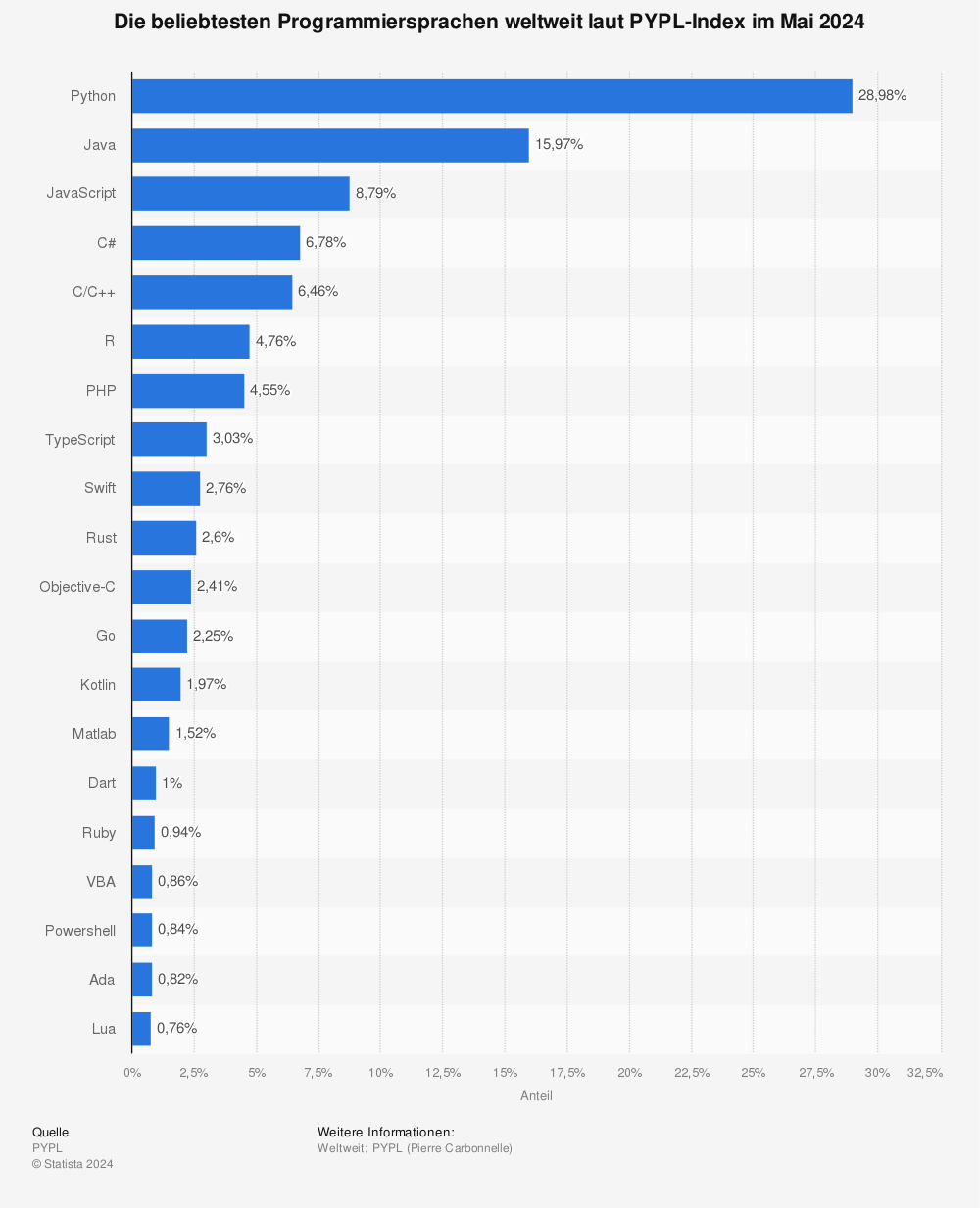
Find more statistics at Statista
Popular Open-Source Programming Languages
Python Python ranks among the most popular open-source languages thanks to its simplicity and readability. It’s widely used for web development, data science, and automation.
JavaScript As the language of the web, JavaScript is essential for frontend development and increasingly powers backend systems as well.
Java Java’s platform independence and robustness make it a favorite for large-scale open-source projects.
C++ Developers in the open-source sector value C++ for performance-critical applications and systems programming.
Ruby Ruby, especially through the Rails framework, is known for efficient web development and an engaged community.
Programming Languages in the IRC Ecosystem
C Many IRC daemons (IRCD) and IRC services are written in C, reflecting the language’s raw performance and control over system resources. C provides the speed and flexibility needed to run stable servers.
C++ C++ is also used for IRC bot development, particularly when complexity and object-oriented design are required.
Python Python is a popular choice for building IRC bots, thanks to its simplicity and powerful networking libraries.
Java Java sees use in IRC bots, especially in environments where cross-platform compatibility matters.
Perl and Tcl Both languages have traditional roots in IRC scripting and bot development. Perl excels at text processing, while Tcl is often valued for its straightforward integration with IRC clients.
Additional Languages
PHP Primarily known for web development, PHP occasionally appears in IRC bot development, particularly for web-based interfaces. However, its RAM consumption is considerable, especially when many clients run only server-side.
Go Go has gained traction in the IRC space recently, offering a sweet spot between Python’s simplicity and C/C++‘s performance.
Rust Rust is rising in prominence, particularly for building high-performance and security-critical IRC tools.
Notes on Individual Languages
C
C is among the oldest and most efficient languages.
Usage: Perfect for developing high-performance IRC servers or bots.
Advantages:
High speed and efficiency. Full control over system resources.
Disadvantages:
Complex to work with. Higher risk of memory management errors.
C++

C++ builds on C and adds object-oriented features.
Usage: Ideal for more complex IRC applications requiring robust architecture.
Advantages:
Combines C’s efficiency with object-oriented benefits. Well-suited for large projects.
Disadvantages:
Can be challenging for beginners. Complex memory management.
Python
Python is renowned for readability and simplicity.
Usage: Perfect for rapidly developing IRC bots or scripts.
Advantages:
Easy to learn and write. Strong community and extensive libraries.
Disadvantages:
Not as fast as C or C++. Execution speed limitations.
Java
Java is a versatile, object-oriented language.
Usage: Good for cross-platform IRC applications.
Advantages:
Platform-independent thanks to the Java Virtual Machine. Comprehensive standard library.
Disadvantages:
Higher memory footprint and potentially slower execution. Sometimes verbose syntax.
C#
C# is Microsoft’s answer to Java and commonly runs in .NET environments.
Usage: Suitable for Windows-based IRC applications.
Advantages:
Strong integration with Windows systems. Excellent support for object-oriented programming.
Disadvantages:
Less cross-platform than Java. Best used alongside other Microsoft products.
JavaScript
JavaScript is the language of the web, primarily used for frontend development.
Usage: Ideal for building web-based IRC clients.
Advantages:
Universal across the web. Large community and numerous frameworks.
Disadvantages:
Mainly limited to browser environments. Can become unwieldy in larger projects.
Ruby
Ruby emphasizes elegance and expressiveness.
Usage: Well-suited for quickly developed, highly readable IRC scripts.
Advantages:
Highly expressive and efficient for rapid development. Ruby on Rails is a powerful web application framework.
Disadvantages:
Performance can be problematic. Smaller community compared to other languages.
PHP
PHP is widespread for web development.
Usage: Can be used for web interfaces of IRC applications.
Advantages:
Widely available across the web. Easy to learn and use.
Disadvantages:
Not ideal for command-line applications. Has security concerns.
Perl
Perl was once the “Swiss Army knife” of the internet and remains powerful for text processing.
Usage: Useful for IRC log processing and analysis.
Advantages:
Excellent for text and data manipulation. Flexible scripting capabilities.
Disadvantages:
More complex syntax than newer languages. Less popular for modern web development.